Robert Feldmann
Associate Professor | Department of Astrophysics, UZH
Collaborations
- The Feedback in Realistic Environment (FIRE) Project
- AGORA Galaxy Simulation Comparison Project
- The SKA Switzerland Consortium (SKACH)
- ARRAKIHS
- UNCOVER
- MINERVA
- SQUGGLE
- Euclid
- Roman Science Collaboration
Research Highlights
Elevated UV luminosity density at Cosmic Dawn explained by non-evolving, weakly mass-dependent star formation efficiency
Recent observations with the James Webb Space Telescope (JWST) have uncovered unexpectedly high cosmic star formation activity in the early Universe, mere hundreds of millions of years after the Big Bang. These observations are often understood to reflect an evolutionary shift in star formation efficiency (SFE) caused by changing galactic conditions during these early epochs. We present FIREbox-HR, a high-resolution, cosmological hydrodynamical simulation from the Feedback in Realistic Environments project, which offers insights into the SFE of galaxies during the first billion years of cosmic time. FIREbox-HR re-simulates the cosmic volume (L = 22.1 cMpc) of the original FIREbox run with eight times higher mass resolution (m_b ~ 7800 M_sun), but with identical physics, down to z ~ 6. FIREbox-HR predicts ultraviolet (UV) luminosity functions in good agreement with available observational data. The simulation also successfully reproduces the observed cosmic UV luminosity density at z ~ 6 - 14, demonstrating that relatively high star formation activity in the early Universe is a natural outcome of the baryonic processes encoded in the FIRE-2 model. According to FIREbox-HR, the SFE - halo mass relation for intermediate mass halos (M_halo ~ 10^9 - 10^11 M_sun) does not significantly evolve with redshift and is only weakly mass-dependent. These properties of the SFE - halo mass relation lead to a larger contribution from lower mass halos at higher z, driving the gradual evolution of the observed cosmic UV luminosity density. A theoretical model based on the SFE - halo mass relation inferred from FIREbox-HR allows us to explore implications for galaxy evolution. Future observations of UV faint galaxies at z > 12 will provide an opportunity to further test these predictions and deepen our understanding of star formation during Cosmic Dawn.
Evolution of the ultraviolet (UV) luminosity density down to a limiting observed rest-frame magnitude of -17 as predicted by the FIREbox-HR cosmological volume simulation (blue solid line and error bars) and by a theoretical model with a non-evolving star formation efficiency (SFE) -- halo mass relation inferred from the simulation (red line and shaded areas). The red line shows the UV luminosity density in galaxies brighter than -17 as predicted by the theoretical model for the same halo mass distribution as in FIREbox-HR, while dark and light shaded areas indicate how the scatter in the SFE affects the UV luminosity in the given volume at the 68 and 95 percent confidence level. Uncertainties (68\% confidence level) of the FIREbox-HR predictions are calculated via bootstrapping and account for both the scatter in SFE and variations in halo numbers. Long and short dashed lines reproduce the predictions of empirical models by Tacchella et al. 2018 and Harikane et al. 2022, and large symbols with error bars show observational estimates by Bouwens et al. 2022, Donnan et al. 2023a, 2023b, Harikane et al. 2023, Adams et al. 2024, Finkelstein et al. 2024 and Donnan et al. 2024. Both FIREbox-HR and the derived theoretical model reproduce the observed evolution of the UV luminosity density at z~6-14.
Predicting high resolution baryon fields from dark matter simulations with Deep Learning
Hydrodynamic simulations provide a powerful, but computationally expensive, approach to study the interplay of dark matter and baryons in cosmological structure formation. Here we introduce the EMulating Baryonic EnRichment (EMBER) Deep Learning framework to predict baryon fields based on dark-matter-only simulations thereby reducing computational cost. EMBER comprises two network architectures, U-Net and Wasserstein Generative Adversarial Networks (WGANs), to predict two-dimensional gas and HI densities from dark matter fields. We design the conditional WGANs as stochastic emulators, such that multiple target fields can be sampled from the same dark matter input. For training we combine cosmological volume and zoom-in hydrodynamical simulations from the Feedback in Realistic Environments (FIRE) project to represent a large range of scales. Our fiducial WGAN model reproduces the gas and HI power spectra within 10% accuracy down to ~10 kpc scales. Furthermore, we investigate the capability of EMBER to predict high resolution baryon fields from low resolution dark matter inputs through upsampling techniques. As a practical application, we use this methodology to emulate high-resolution HI maps for a dark matter simulation of a L = 100 Mpc /h comoving cosmological box. The gas content of dark matter haloes and the HI column density distributions predicted by EMBER agree well with results of large volume cosmological simulations and abundance matching models. Our method provides a computationally efficient, stochastic emulator for augmenting dark matter only simulations with physically consistent maps of baryon fields.
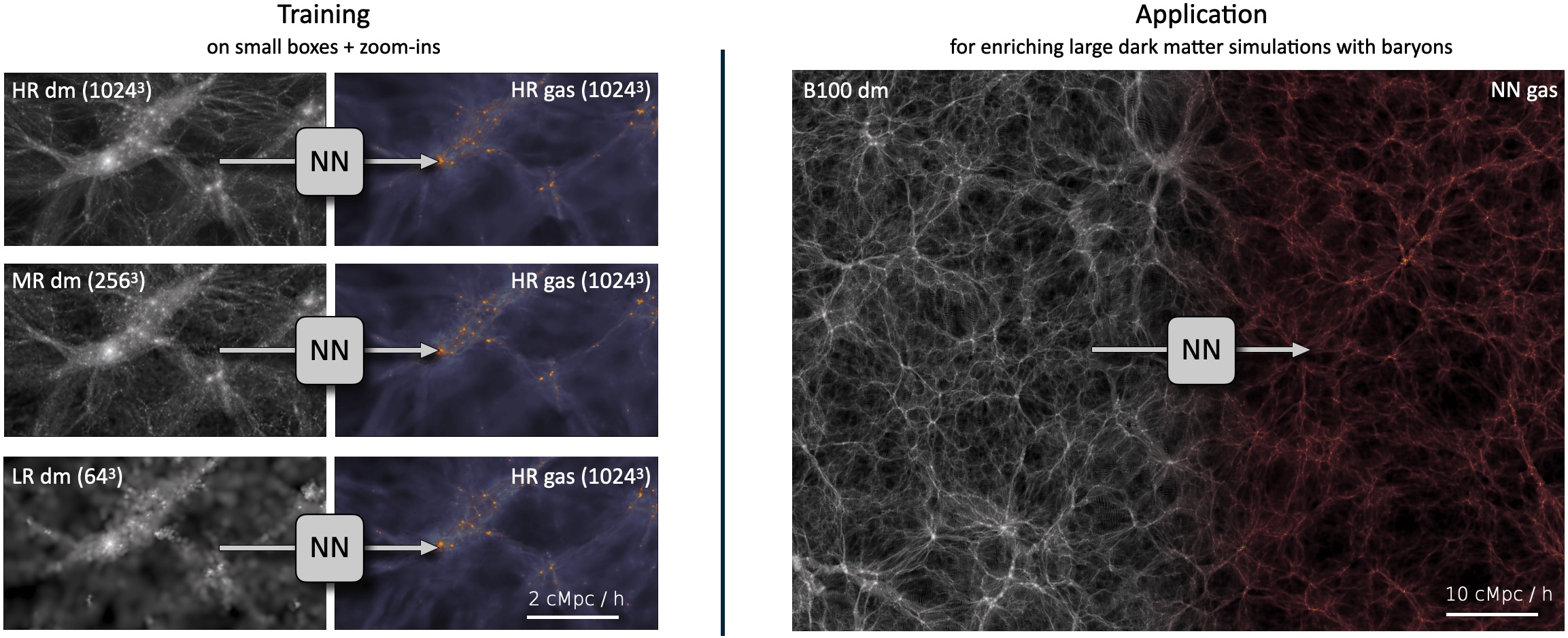
Illustration of our machine learning pipeline. We train neural networks on small cosmological volumes and zoom-in simulations with high resolution to predict baryonic counterparts from dark matter inputs. We investigate the upsampling capabilities of the networks by training individually on different darkmatter input resolutions (indicated on the left in the training figure), while the target fields are always fixed to the highest resolution (see section 4.5 for details). As indicated on the right, the trained neural networks can then be applied to large dark matter only simulations to enrich them with the specified baryon fields at low computational cost.
Colors, Star formation rates, and Environments of Star forming and Quiescent Galaxies
We analyse the star formation rates (SFRs), colors, and dust extinctions of galaxies in massive (10^12.5-10^13.5 Msun) halos at z~2 in high-resolution, cosmological zoom-in simulations as part of the Feedback in Realistic Environments (FIRE) project. The simulations do not model feedback from active galactic nuclei (AGN) but reproduce well the observed relations between stellar and halo mass and between stellar mass and SFR. About half (a third) of the simulated massive galaxies (massive central galaxies) at z~2 have broad-band colors classifying them as 'quiescent', and the fraction of quiescent centrals is steeply decreasing towards higher redshift, in agreement with observations. The progenitors of z~2 quiescent central galaxies are, on average, more massive, have lower specific SFRs, and reside in more massive halos than the progenitors of similarly massive star forming centrals. The simulations further predict a morphological mix of galaxies that includes disk-dominated, irregular, and early-type galaxies. However, our simulations do not reproduce the reddest of the quiescent galaxies observed at z~2. We also do not find evidence for a color bimodality, but are limited by our modest sample size. In our simulations, the star formation activity of central galaxies of moderate mass (Mstar~10^10-10^11 Msun) is affected by a combination of two distinct physical processes. Outflows powered by stellar feedback result in a short-lived (<100 Myr), but almost complete, suppression of star formation activity after which many galaxies quickly recover and continue to form stars at normal rates. In addition, galaxies residing in slowly growing halos tend to experience a moderate reduction of their SFRs ('cosmological starvation'). The relative importance of these processes and AGN feedback is uncertain and will be explored in future work.
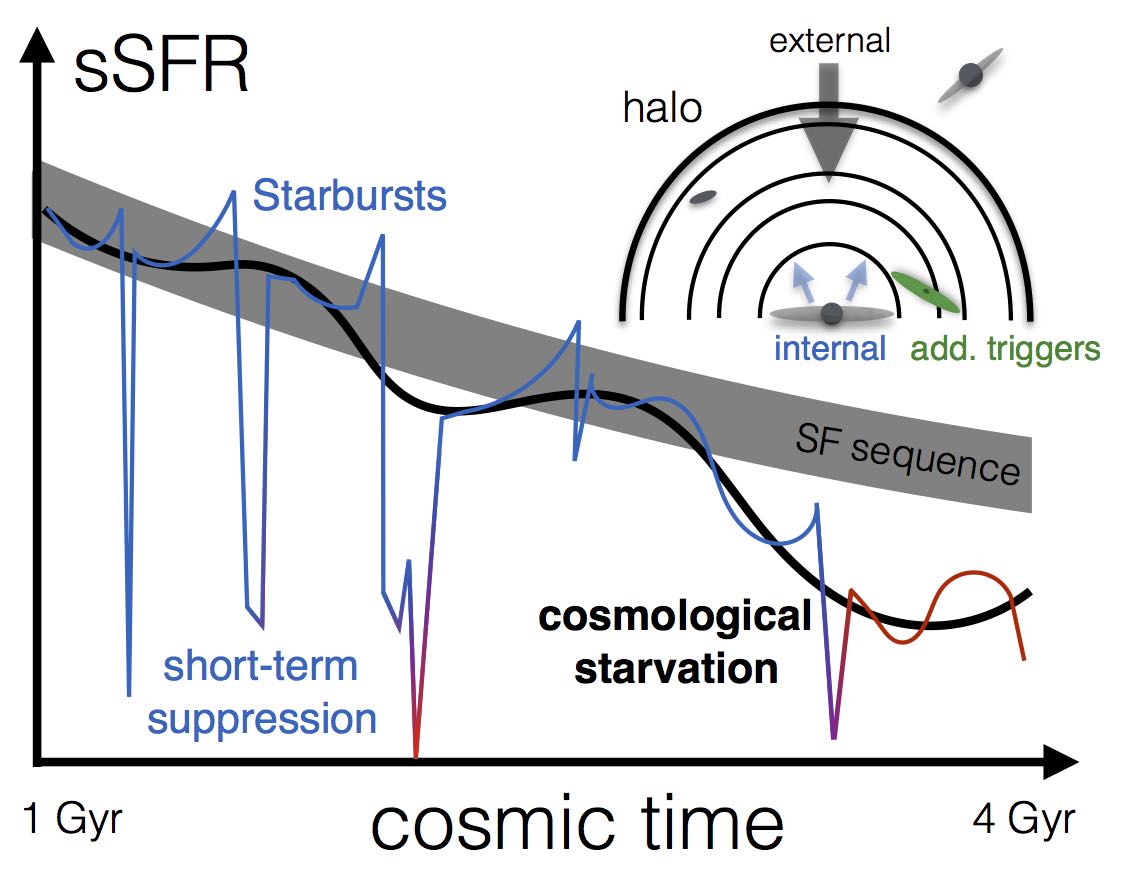 |
Illustration of how the star formation rates (SFRs) of massive, central galaxies evolve with cosmic time. This schematic view does not account for feedback from active galactic nuclei. At early times (z≥3), the specific SFRs (sSFRs; SFR per unit stellar mass) of central galaxies evolve along the star forming sequence. However, starbursts and outflows triggered by various internal and external processes can result in brief, but severe, interruptions. In addition, external drivers, such as cosmological starvation, affect the star formation histories on comparably long times scales and strongly modulate galaxy colors. |
The Formation of Quiescent Galaxies at the Cosmic Noon
The cosmic noon (redshifts ~1.5–3) marked a period of vigorous star formation for most galaxies. However, about a third of the more massive galaxies at those times were quiescent in the sense that their observed stellar populations are inconsistent with rapid star formation. The reduced star formation activity is often attributed to gaseous outflows driven by feedback from supermassive black holes, but the impact of black hole feedback on galaxies in the young Universe is not yet definitively established. We analyse the origin of quiescent galaxies with the help of ultrahigh resolution, cosmological simulations that include feedback from stars but do not model the uncertain consequences of black hole feedback. We show that dark matter halos with specific accretion rates below ~0.25–0.4 Gyr^-1 preferentially host galaxies with reduced star formation rates and red broad-band colors. The fraction of such halos in large dark-matter-only simulations matches the observed fraction of moderately massive, quiescent galaxies (with stellar masses of ~10–100 billion solar masses). This suggest that halo accretion rate may be an important factor in deciding which massive galaxies at cosmic noon become quiescent. Empirical models that connect galaxy and halo evolution, such as halo occupation distribution or abundance matching models, assume a tight link between galaxy properties and the masses of their parent halos. These models will benefit from adding the specific accretion rate of halos as a second model parameter.
 |
Comparison between the growth rate of baryonic masses (stars, atomic, and molecular hydrogen) of galaxies and the dark matter masses of their parent halos. Red circles and blue squares show quiescent and star-forming galaxies, respectively. The classification is based on rest-frame U−V and V−J colors. Filled and empty symbols denote galaxies that are centrals or satellites. Symbol sizes reflect stellar masses (see legend). The solid line marks a 1:1 relationship and is not a fit. Galaxies residing at the centres of fast growing halos are essentially always strongly star forming. In contrast, slowly growing (or even shrinking) halos typically harbour quiescent galaxies. |
The Formation of submillimeter bright galaxies
Submillimeter-luminous galaxies at high-redshift are the most luminous, heavily star-forming galaxies in the Universe, and are characterized by prodigious emission in the far-infrared at 850 microns (S850 > 5 mJy). They reside in halos of 10 trillion solar masses, have low gas fractions compared to main sequence disks at a comparable redshift, trace complex environments, and are not easily observable at optical wavelengths. Their physical origin remains unclear. Galaxy evolution simulations have been able to form galaxies with the requisite luminosities, but have otherwise been unable to simultaneously match the stellar masses, star formation rates, gas fractions and environments. We report on a cosmological hydrodynamic galaxy formation simulation that is able to form a submillimeter galaxy which simultaneously satisfies the broad range of observed physical constraints. We find that groups of galaxies residing in massive dark matter halos have rising star formation histories that peak at collective rates ~ 500-1000 solar masses per yr at redshift 2-3, by which time the interstellar medium is sufficiently enriched with metals that the region may be observed as a submillimeter-selected system. The intense star formation rates are fueled in part by a reservoir gas supply enabled by stellar feedback at earlier times, not through major mergers. With a duty cycle of nearly a gigayear, our simulations show that the submillimeter-luminous phase of high-z galaxies is a drawn out one that is associated with significant mass buildup in early Universe proto-clusters, and that many submillimeter-luminous galaxies are actually composed of numerous unresolved components (for which there is some observational evidence).
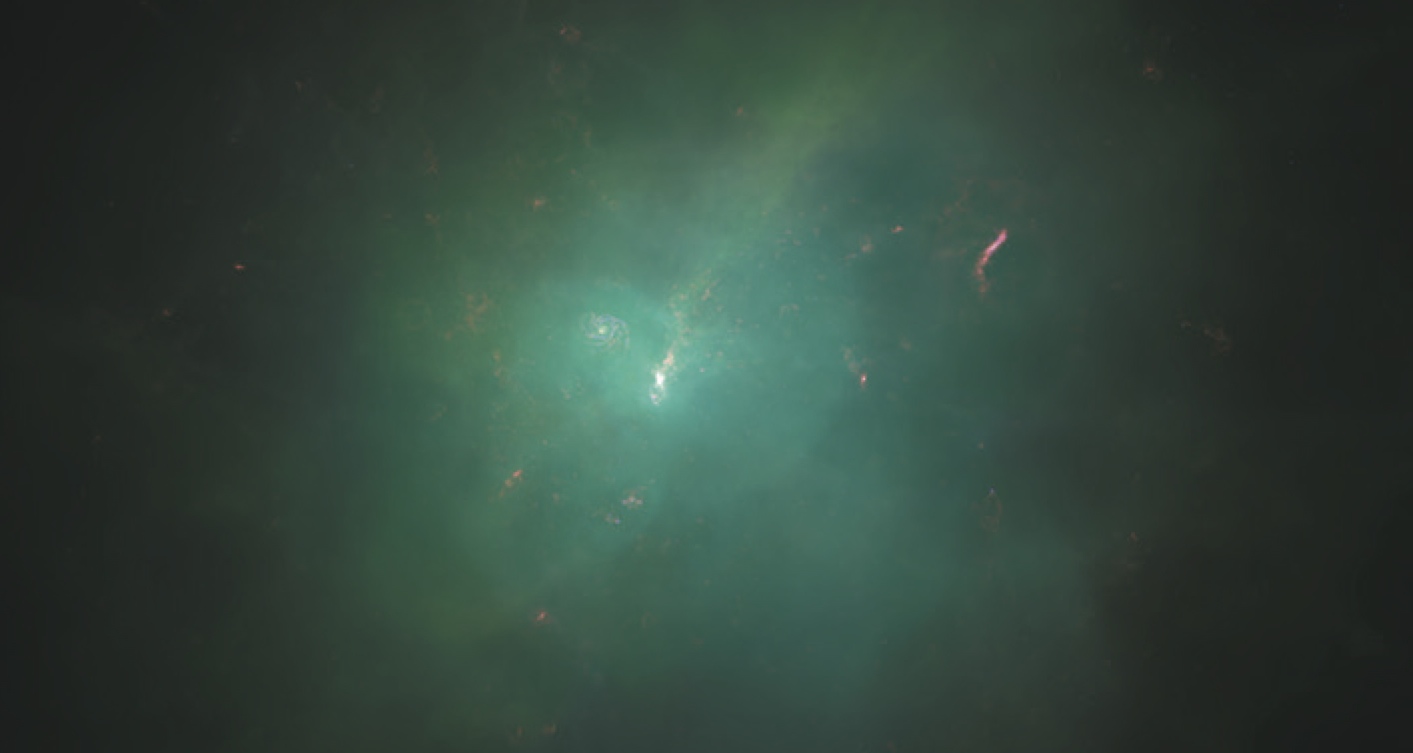
Snapshot, taken from a supercomputer simulation, depicting the distribution of gas and light in a small region around a submillimeter-luminous galaxy (SMG): it contains a bright central galaxy (white) that is accreting gas along a filamentary structure (pink), a large spiral galaxy (left of center), and numerous smaller galaxies that contribute to the total luminosity of the SMG. Ambient gas (blue-green), much of which was expelled by the galaxies at earlier epochs, gravitates towards the center of the proto-SMG. This fuels the prodigious star-formation activity of the system, which is unlike anything seen in the present-day Universe. [ from the News & Views article by R. Dave ]
Detecting dark matter substructres with GAIA
Cold Dark Matter (CDM) theory, a pillar of modern cosmology and astrophysics, predicts the existence of a large number of starless dark matter halos surrounding the Milky Way (MW). However, clear observational evidence of these "dark" substructures remains elusive. We propose a detection method of orbiting substructure that relies on the small velocity changes imposed on the stars in the MW disk. Using high-resolution numerical simulations we estimated that the new space telescope Gaia should detect the kinematic signatures of a few starless substructures provided the CDM paradigm holds. Such a measurement will provide unprecedented constraints on the primordial matter power spectrum at low-mass scales and offer a new handle onto the particle physics properties of dark matter.
 |
Kinematic signature of a low mass substructure passing vertically through the disk of the MW. Each panel shows a velocity map of the face-on stellar disk of the MW model at a different time (see legend). The galactic center (white cross) is at X = Y = 0. Panels A through E show the change in vertical velocity caused by the gravitational pull of the substructure in 500 x 500 pc^2 bins. Upward (downward) motions are shown in red (blue) colors. The blue (white) circle in each panel indicates the projected center of mass of the substructure when it is above (below) the MW disk plane. We show the position of the substructure in a frame co-rotating with the mean tangential velocity of stars at 8 kpc from the galactic center. The MW–substructure interaction results in well-localized maxima and/or minima of the vertical velocity of disk stars, visible in panels A–D. |