Maksutov-Cassegrain 300mm
A Telescope with a History
The Maksutov from Sternenberg Observatory
This Maksutov Cassegrain telescope, with a mirror diameter of 300 mm and a focal length of 4.80 m, was in use at the private Sternenberg Observatory in the Zurich Oberland from 1966 to 2013. Today, it can be seen on permanent loan at the Institute of Astrophysics at the University of Zurich. The instrument stands not only for precise observation of the sky, but also for a personal and remarkable story: for the passion of an observatory builder, for craftsmanship of a high order, and for the fascination of looking into space.
The telescope: structure, function, and origin
The instrument displayed here is a so called Maksutov Cassegrain telescope. This type of telescope combines a compact design with high optical performance. Its basic principle rests on the interaction of mirrors and a correcting lens. Incoming light first passes through a meniscus lens mounted at the front, is then reflected by a primary mirror at the rear end of the tube, and is finally directed back to the eyepiece by a secondary mirror. This design makes it possible to achieve a long focal length while keeping the telescope itself relatively short. That is one of the reasons why Maksutov Cassegrain systems are particularly well suited for observing the Moon, the planets, and other high contrast celestial objects.
-
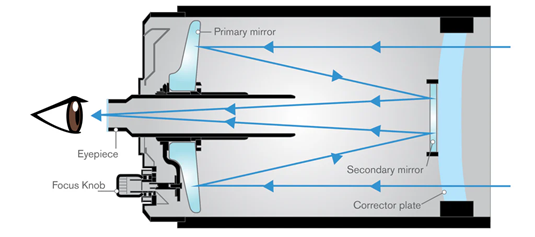
- Schematic structure of a Maksutov Cassegrain telescope with Corrector plate (meniscus lens), primary mirror, and secondary mirror.
Historically, the name refers to two figures: the French cleric Laurent Cassegrain, whose name is associated with the Cassegrain mirror arrangement, and the Russian optician and astronomer Dmitri Dmitrievich Maksutov, who developed the meniscus corrector lens in 1942. This lens reduces optical aberrations and at the same time allows for an especially compact design. To this day, Maksutov systems are regarded as an elegant combination of optical quality and mechanical practicality.
A particularly important aspect of this exhibit is its maker, Eugen Popp. He not only manufactured the optics for his telescopes in his own workshop, but also calculated them himself. In specialist circles, Popp was considered one of the few telescope makers of his time who could independently produce the demanding spherical surfaces of a Maksutov system with great precision. This included both the primary mirrors and the complex meniscus lenses. It was precisely this complete control over the entire optical chain that made his instruments known in the 1960s and 1970s for their exceptional sharpness and high contrast. Popp was therefore not simply a producer, but a specialist with the standards of a craftsman maker. While many telescope builders worked with purchased components, he carefully matched the individual optical elements of his instruments to one another. This in house production also allowed him to make unusual apertures and custom built systems. The telescope shown here therefore stands not only for astronomical observation, but also for a piece of Swiss precision engineering and optical craftsmanship.
The story of the telescope: from Sternenberg to Zurich
For almost five decades, this telescope was closely connected with the private Sternenberg Observatory. From 1966 to 2013, it was used to give visitors a view of the Moon, the planets, and the night sky. The observatory itself was built in 1965 and 1966 on Schatzböhl in the Zurich Oberland, at a location with clear air, little stray light, and a good view of the sky.
-
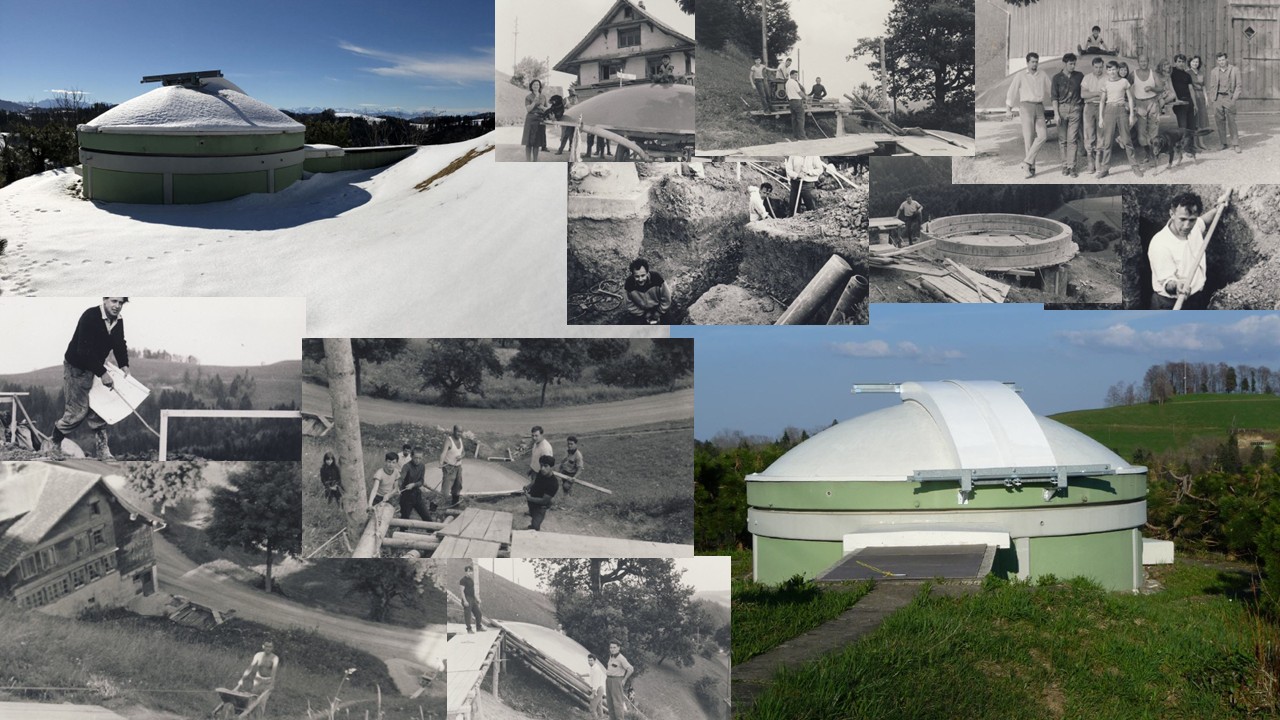
- Sternenberg Observatory in historical and recent photographs. Source: sternwarte-sternenberg.ch
The observatory was built by Karl Küenzi, together with his wife Edeltraud, his half brother Heinz Wagner, and with the support of friends, acquaintances, and work colleagues from the construction company Alfredo Piatti. The construction was demanding. The materials had to be brought up the steep hillside, the dome was pulled into place with a motorised winch, and the excavation work was done by hand.
At the inauguration of this exhibit during the photo exhibition on 16 March 2026, Jacqueline Küenzi, the daughter of Karl Küenzi, spoke about her father’s life story. He was born in 1930 in Sternenberg and grew up in simple and deprived circumstances. Even so, by the age of eleven or twelve he was already interested in the natural sciences and in the question of the origin of the universe, in an environment shaped by religious ideas and sceptical of scientific thinking. Jacqueline Küenzi recalled a conversation with her father on the very hill where the observatory stands. There, he said to her: “As a child I used to sit here quite often, looking at the beauty of the cosmos, and I asked myself: how did all that come into being. You know, I never believed in god and all those fairy tales they were telling in church and school.”
Although he was denied a higher education, Karl Küenzi continued to educate himself through his own efforts. With the first money he earned himself, he bought French grammar and vocabulary books, taught himself French, and eventually went to the French speaking part of Switzerland, where he completed an apprenticeship as a bricklayer. University study remained out of reach, but as an autodidact he acquired extensive knowledge in civil engineering, astronomy, geology, history, and music. The idea of building an observatory in Sternenberg stayed with him for years until it became reality in the mid 1960s.
It was during this period that contact was established with Eugen Popp, the maker of this Maksutov telescope. Popp used the observatory to show his instrument to interested visitors, and Karl Küenzi was later able to acquire the telescope at a favourable price. In this way, the Maksutov became the defining instrument of the observatory and, for many people, their first window into space. For Jacqueline Küenzi, this telescope is still tied to an early and lasting memory. At the end of her speech, she said: “it was this Maksutov that first beamed me towards the moon. Therefore, I'm happy that it's now here and, even if no one will look at the sky with it anymore, it will still be looked at."
Please visit sternwarte-sternenberg.ch for more information about the observatory or for booking private tours.
You can read the full speech of Jacqueline Küenzi here: Speech_Jacqueline Küenzi (PDF, 40 KB)