Specialized Master in Computational Science
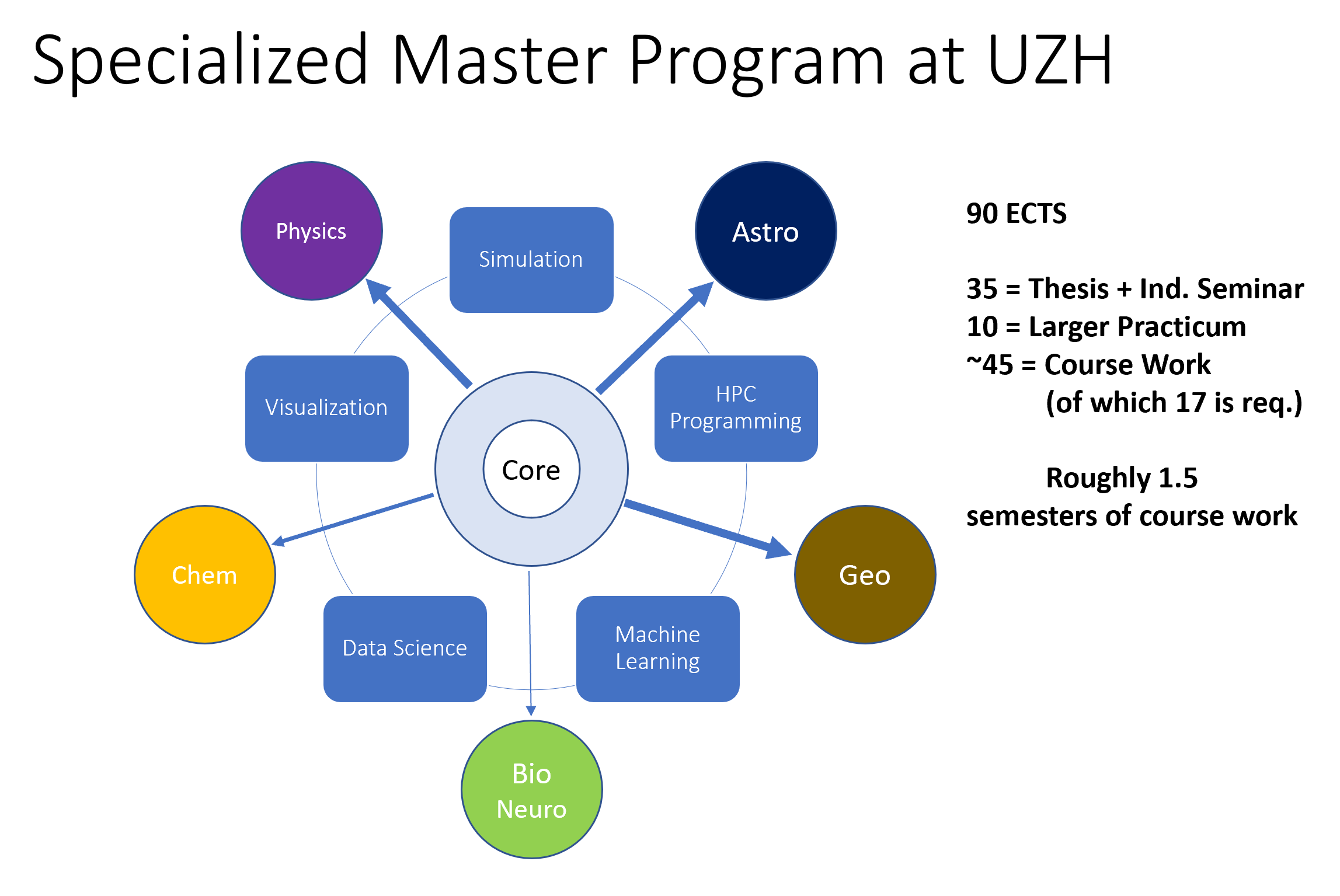
The rapid development of computational methods and the ever-increasing power of modern computers have fundamentally transformed how scientific problems are approached. Today, many of the most exciting challenges in the natural sciences are tackled through a combination of scientific insight, mathematical modeling, and advanced computation.
The Master’s program in Computational Science (90 ECTS credits Mono or 90 ECTS Major with a 30 ECTS Minor) is designed for students with a background in the natural sciences or computer science who want to work at this interface. It equips students with the skills to formulate, analyze, and solve complex scientific problems using modern numerical, algorithmic, and data-driven methods. Core courses provide a strong foundation in simulation techniques, scientific computing, and data analysis, while emphasizing algorithmic thinking and efficient implementation.
A key feature of the program is its strong practical orientation: students gain hands-on experience in coding, software development, and scientific project work, preparing them to translate theoretical concepts into working computational tools. Through a wide range of elective courses, students can further specialize methodologically or deepen their expertise in application areas such as astrophysics, physics, chemistry, geosciences, and related fields.
By combining methodological rigor with application-driven learning, the program prepares graduates to contribute to cutting-edge research in academia and to meet the growing demand in industry for experts who can bridge the gap between scientific inquiry and advanced computation.
*** We do not compensate foreign or local MSc students ***
*** This is the Master program in Computational Science. For the Master program in Computer Science, see here ***
Program structure
The Specialized Master in Computational Science has a core that focuses on general principles (Methodological Foundations, Numerical Methods for Differential Equations in Simulations, Advanced High-performance Computing, Methods for Visualizing Simulation Data, Machine Learning in Science). The core courses all have a strong practical component in code development and programming. In addition, there are electives with a focus on the hands-on aspect. Possible directions include Computational Physics and Astrophysics, Computational Chemistry, Computer Graphics, Applications in Earth and Environmental Sciences.
In outline, the program is (highlighted modules take place in the spring semester):
| Compulsory Modules | ECTS credit points | |
| ESC203 Advanced Simulations in the Natural Sciences | 5 | |
| ESC412 Advanced High Performance Computing (note below) | 5 | |
| PHY371 Machine Learning for the Sciences | 5 | |
| ESC406 Computational Thinking II | 2 | |
| ESC413 Computational Thinking I | 2 | |
| ESC411 Individual seminar work on given topic | 5 | |
| ESC500 Master thesis | 30 | |
| Elective Modules | ECTS credit points | |
| ESC414 Practicum in Advanced Simulation Science | 10 | |
| ESC415 Internship in Computational Science | 6 | |
| ESC802 Academia Industry Modelling (AIM) week | 2 | |
| ESC204 Computational Methods for Radiative Transfer | 5 | |
| ESC405 Big Data for Natural Sciences | 3 | |
| AST245 or AST246 Computational Astrophysics | 6 or 10 | |
| PHY522 Computational Quantum Physics | 8 | |
| PHY582 Advanced Quantum Algorithms | 6 | |
| INI427 Models of Computation | 6 | |
| GEO442 Remote Sensing: Spectroscopy of the Earth System | 6 | |
| GEO877 Spatial Algorithms | 3 | |
| CHE 747 Quantum Chemistry | 2 | |
| CHE437 Surface and Interface Science | 4 | |
| M3L521 AI4Good | 6 | |
| MINFS520 Advanced software engineering | 3 | |
| (MINF4557 Advanced computer graphics) | 6 | |
| BMINF002 Computer Graphics | 3 | |
|
101-0692-00L Selected Topics in Computational Mechanics (ETHZ) |
3 | |
| Numerical Methods for Hyperbolic Partial Differential Equations (spring '22 at ETHZ: 401-3652-00 , spring '23 at UZH: MAT827, etc.) | 10 | |
| irregular (takes place in fall 2022) MAT933 Complex Networks Theory and Applications | 6 | |
| irregular: MAT837 Very high order methods for hyperbolic problems | 6 | |
|
401-4944-20L Mathematics of Data Science (at ETHZ) |
8 |
Admission requirements
Admission to the specialized Master's program is by application.
The specialized mono/major study program Computational Science (note: not Computer Science) at Master's level requires a Bachelor of Science degree with:
- A major in a natural science (e.g., Astrophysics, Biology, Chemistry, Geography, Physics) with a minor in Computational Science or Computer science (Informatics); or
- A major in a computational field with a minor in a natural science or Computational Science.
Interest in both computing and natural science are prerequisites for applying. Please note that having 1st year introductory courses in the natural sciences (listed above) is not considered sufficient.
In certain cases, students will be required to additionally take courses to fulfil the entry requirements.